We have updated our Privacy Policy, click here for more information.
Thank you


Published: June 30, 2026
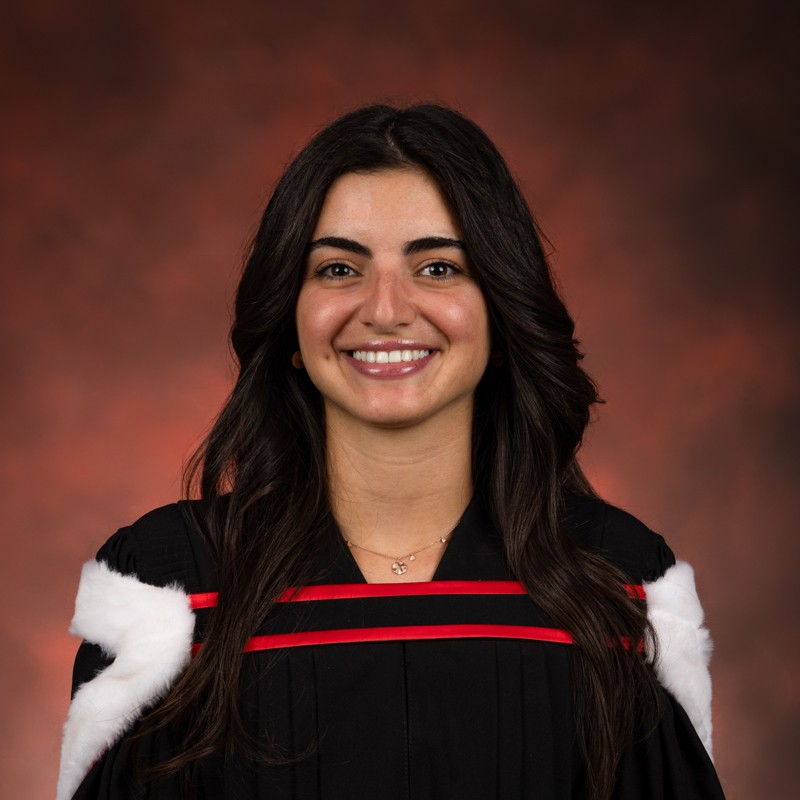
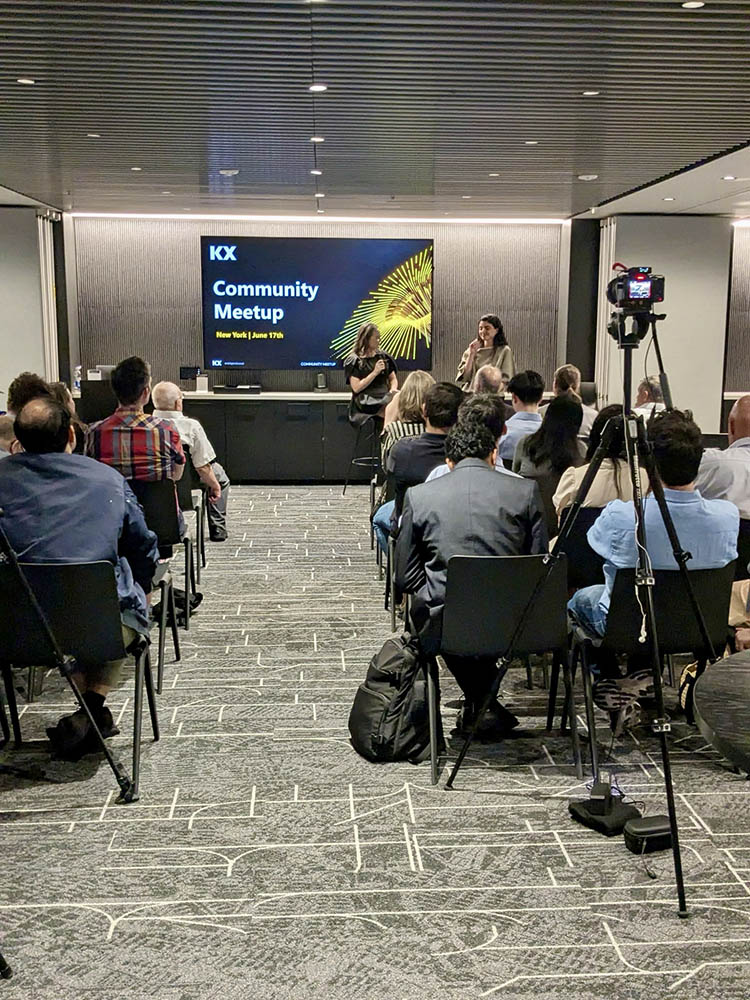
Historically, kdb+ has been a highly specialized technology typically learned on the job rather than in an academic classroom. Most developers encounter it while working on trading floors, within quantitative teams, or through professional networks. That’s what made the KX NYC Meetup on June 17th so noteworthy. Hosted in a beautiful Midtown Manhattan venue, the event drew a packed room of kdb+ developers, clients, and — perhaps most surprisingly — self-taught students applying kdb+ to finance and exploring its applications in the Formula 1 space.
With attendees flying in from other cities, it is clear the community is expanding.
First Derivative is a key part of this world. As a long-term partner of KX, FD has supported the KDB+/Q community for decades. Because our consultants work directly with clients across the financial industry, we have a clear view of how firms run and update their KDB+ systems in real time. This active role was clear at the meetup, with many FD consultants in the room and representatives speaking on stage.
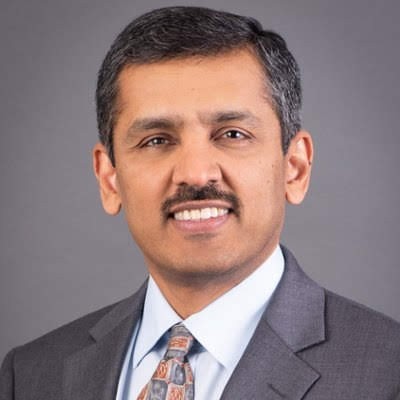
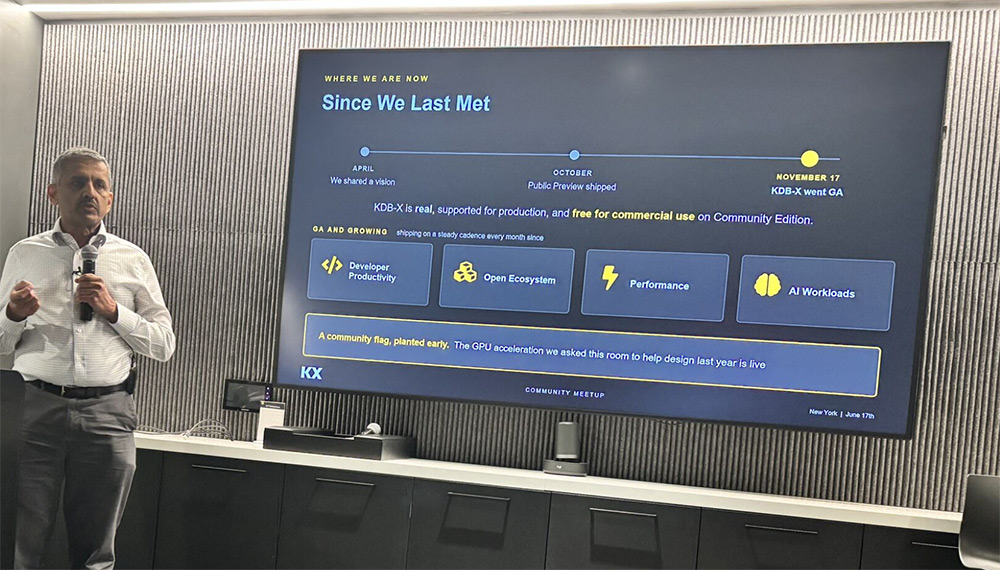
KX CEO Ashok Reddy opened the evening with two game-changing announcements: first, kdb-x is now freely accessible for commercial use (via the KDB-X Community Edition), drastically lowering the barrier to entry. Second, GPU acceleration is officially live—with a client already utilizing it. As data volumes climb, these updates change what is architecturally possible.
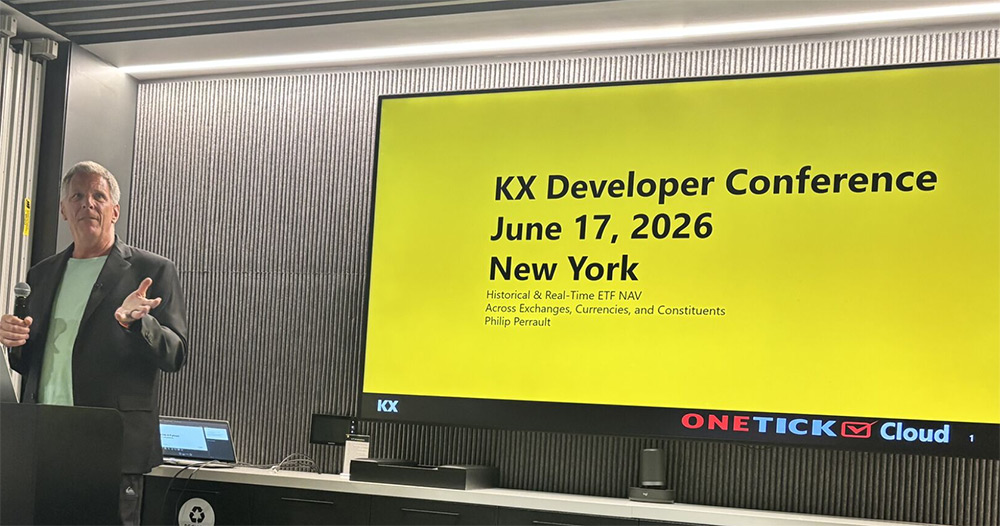
Philip Perrault, Senior Pre-Sales Engineer at OneTick, walked us through historical and real-time ETF NAV tracking across exchanges, currencies, and constituents. It was a stellar live demo that showed exactly what OneTick does — and for many in the room, that high-level clarity was long overdue.
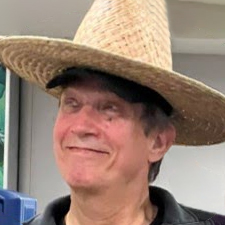
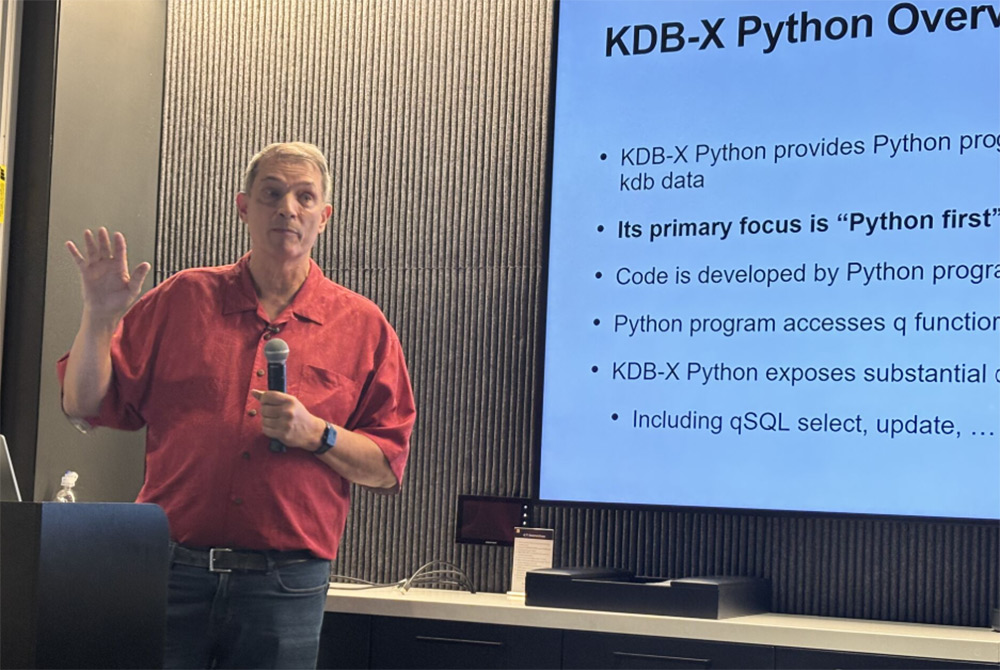
Jeffry Borror, author of Q for Mortals, walked us through PyKX. He demonstrated how Python and q integrate seamlessly, how to use PyKX’s Python context to auto-load environments, and how top-level Python calls q code underneath. It was practical, clear, and clicked for a lot of people in the room.
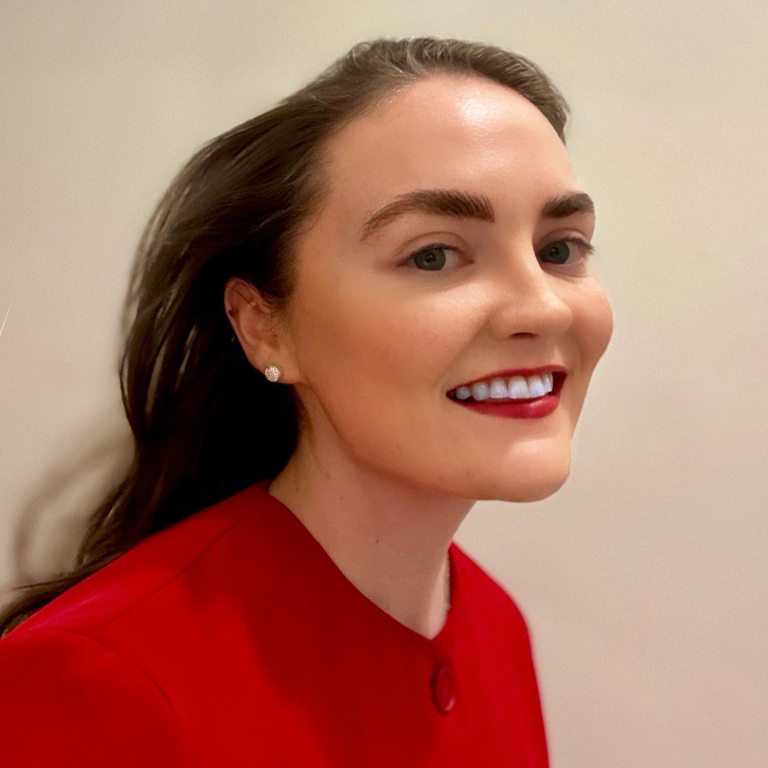
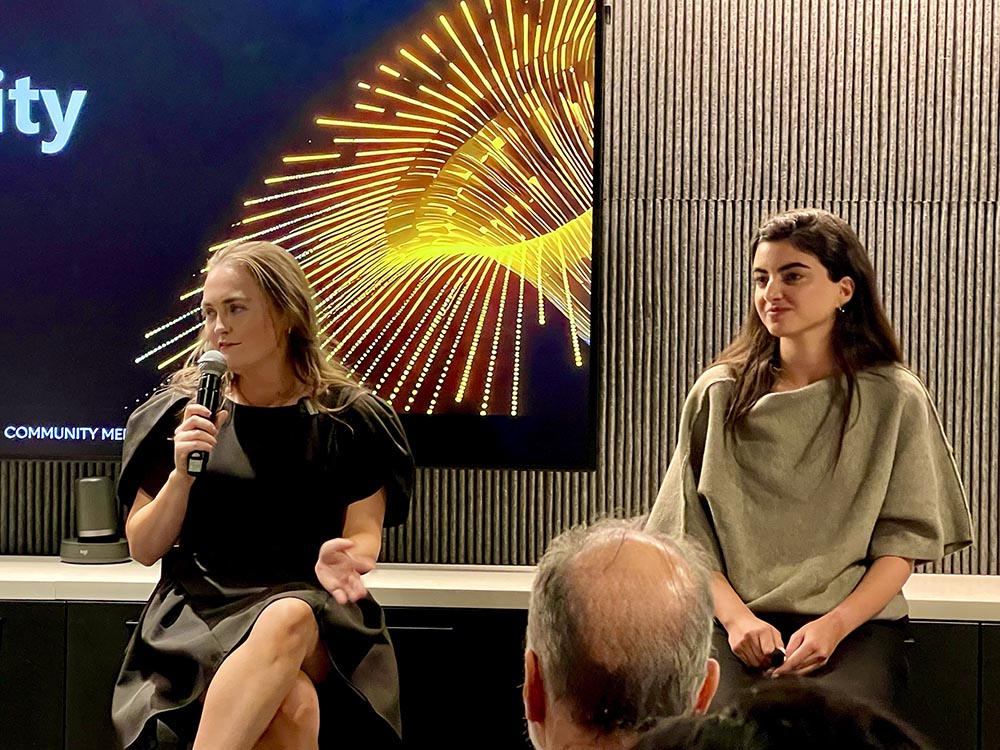
Leah Spillane, senior KDB+/Q developer and a colleague and friend, joined me to close the speaker lineup with a candid conversation about running KDB+ infrastructure in today’s environment — high volatility, record volumes, and systems under constant pressure.
The core message: the architecture that got you here may not carry you forward. The firms managing well invested proactively. The ones struggling are patching systems never designed for this volume. To resolve these performance bottlenecks during high-stress market events, exploring GPU acceleration is an incredibly interesting path to explore.
We discussed how market surveillance is being directly affected by volatility — regulatory rules are shifting faster than firms can keep up, and AI is reshaping how we approach that challenge, helping surface the blind spots that existing rule sets weren’t built to catch.
We also touched on EPAM’s new partnership with Anthropic, which will have our engineers become Anthropic-certified — deepening our collaboration with Claude and AI across the work we do. On that note, First Derivative and One Tick are partnering to host upcoming surveillance webinars — a natural next step given the overlap between market surveillance challenges and One Tick’s data expertise. More to come on that front.
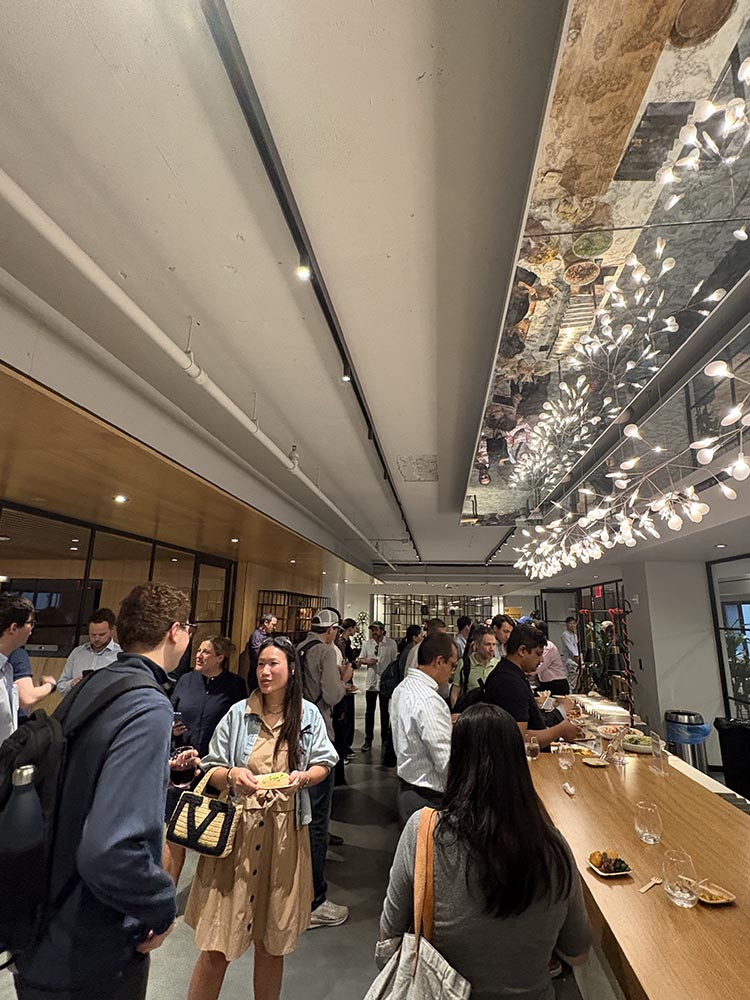
Three lucky attendees walked away with copies of Q for Mortals, and then the floor opened up. Great conversations, new connections, and the 2026 FIFA World Cup humming on screens in the background. It was a very good night to be in New York.
Thanks
Yasmina