We have updated our Privacy Policy, click here for more information.
Thank you




The conversation around artificial intelligence in financial services is changing. The focus is no longer simply on whether organisations should adopt Generative AI (GenAI), but how they can govern it responsibly and ensure it delivers reliable outcomes.
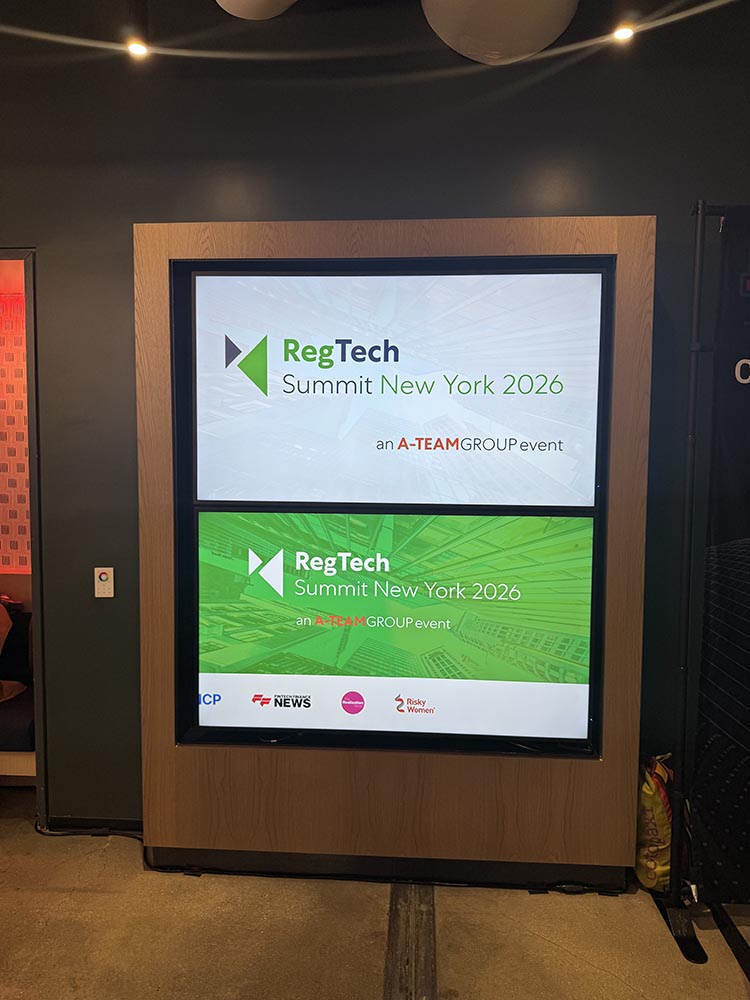
This was a key takeaway from the recent RegTech Summit NY, where discussions highlighted the importance of strong governance, data quality and accountability as financial institutions continue to embrace technological innovation.
As GenAI becomes increasingly embedded in financial services, regulatory expectations are evolving. Discussions involving regulators such as the New York State Department of Financial Services (NYDFS) and the Commodity Futures Trading Commission (CFTC) reinforced the importance of explainability, accountability and effective third-party oversight.
Financial institutions need to understand not only what their AI systems are doing, but also how decisions are reached, what data informs them and who is responsible for the outcomes.
Governance must therefore be considered from the outset, rather than introduced once technology is already in place. Organisations that successfully balance innovation with appropriate controls will be best positioned to realise the benefits of GenAI.
Another recurring theme was the importance of breaking down data silos.
Across transaction surveillance, regulatory reporting and Know Your Customer (KYC), fragmented data environments continue to create challenges for financial institutions. Information spread across multiple systems makes it difficult to establish a complete and consistent view.
Bringing structured and unstructured data together can provide richer insights, improve risk identification and support better decision-making.
However, even the most sophisticated AI solutions depend on the quality and integrity of their underlying data. AI cannot compensate for poor data foundations.
Regulatory reporting remains another significant challenge. Too often, organisations address data issues at the point of submission rather than where information is originally created or captured.
This leads to manual intervention, repeated reconciliation and unnecessary operational complexity.
A more effective approach is to embed data quality, validation and ownership into upstream processes. By addressing issues at source, financial institutions can reduce downstream errors and build greater confidence in their regulatory submissions.
This also requires collaboration across technology, operations, risk and compliance teams, recognising data quality as an organisation-wide responsibility.
The discussions at RegTech Summit NY reinforced a broader shift in financial services. GenAI presents significant opportunities to improve efficiency, strengthen surveillance and enhance decision-making, but its success depends on more than the technology itself.
Strong data foundations, effective governance and clear accountability must underpin innovation.
As regulatory expectations continue to evolve, financial institutions should be asking not simply how quickly they can adopt new technology, but whether their data and operating models are ready to support it.
The future of RegTech will be shaped not just by how intelligent our technology becomes, but by how effectively we govern it and the quality of the foundations on which it operates.
Thanks Barry