We have updated our Privacy Policy, click here for more information.
Thank you



Why financial firms must close the gap between AI capability and organisational readiness

– Robert Frost
At EPAM’s Applied Agentic AI in Financial Services event in Zurich, a powerful graph captured a critical moment for today’s enterprises. One curve shows the rapid rise of AI capabilities; the other, organisational readiness to adopt these advances. The gap between them is growing and it explains a puzzling paradox: while over 80% of financial firms have started using agentic AI, fewer than 10% have managed to scale it.
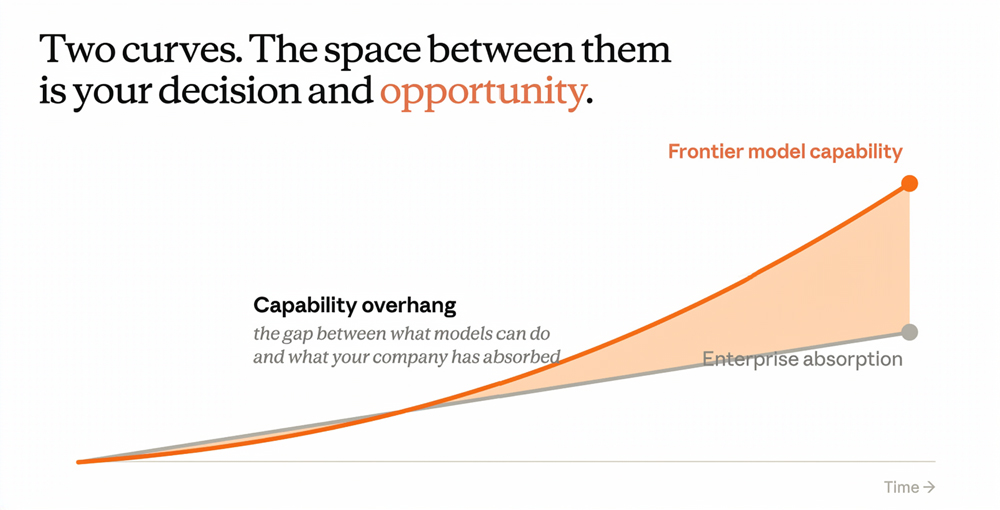
The two curves, as presented at EPAM’s Applied Agentic AI in Financial Services event.
The true bottleneck is no longer what the technology can do, but how quickly organisations can adapt their people, processes and governance.
To successfully take the road less travelled, financial leaders must navigate three fundamental shifts.
We have all settled on a comfortable phrase: “human in the loop.” It sounds responsible. But it assumes that machines run the process while a human simply reviews the work at the end.
It’s time to switch it up. The new standard is “human in the lead.” The human drives, the AI agents support and accountability remains strictly with the human.
It sounds like a small change. It isn’t. Consider Klarna’s experience. In 2024, the company replaced around 700 service roles with AI agents, only to realise by 2025 that relying too heavily on cost reduction compromised quality, prompting them to rehire staff into a hybrid model.
The lesson wasn’t that AI doesn’t work. It’s that treating people as an overhead to cut, rather than expertise to build on, is a flawed design.
As routine analysis is handed over to AI, the traditional corporate pyramid will transform into a diamond shape.
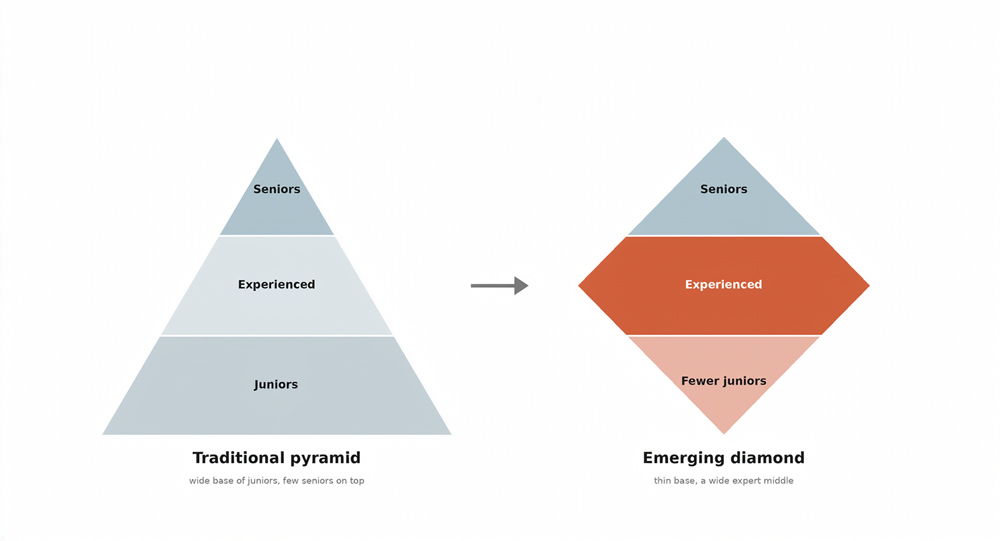
As AI absorbs routine work, the workforce shifts from a pyramid to a diamond.
The idea that stayed with me most came as a story.
A company built a new campus. No pre planned paths, just grass. Over time, people naturally wore tracks into the lawn where paths made the most sense. Those tracks were where the paths got paved.
That is almost the opposite of how most firms roll out AI. A central team sits behind closed doors, prescribes the official use cases and hands them down. This results in low adoption.
A better approach is to let the paths appear organically.
Instead of inventing hypothetical use cases, central teams should build the shared, governed and reusable foundations that everyone else already relies on.
The regulated caveat: “letting people experiment” cannot mean letting answers wander, especially in financial services, where consistency, suitability and regulation are paramount. Successful teams blend technologies, using AI for personalised insights paired with strict deterministic rules to check market data, costs and regulatory compliance.

The client faced a classic operational bottleneck familiar to large scale infrastructure environments. Over 100 routine GCP infrastructure tickets each month covering service accounts, permission adjustments, and new project setups were sitting in queues for two to four days before being addressed.
To overcome this, the EPAM platform team built and launched an autonomous AI agent designed to streamline infrastructure workflows and drastically accelerate delivery times. Developed in just 10 weeks from a local proof of concept into full production, the AI agent has been live since September 23rd 2026.
To ensure rigorous guardrails, four ticket types run fully unattended: service accounts, secrets, permission grants, and dataset access.
Unattended criteria require:
In September alone, 45 runs self-stopped safely with zero undeclared changes applied, backed by 3,186 automated checks prior to any AI agent update.
The economics of AI are shifting at a breathtaking pace. The claim in the room was that token costs are plunging by a factor of 10 to 40 every year. In roughly 20 months, today’s top-tier model capability will cost the same as today’s cheapest model.
Think of electricity. What was once carefully monitored and rationed eventually became so cheap that we stopped noticing it: chargers left plugged in, screens on standby, hallways lit. We built whole cities on the assumption that power is simply there.
Intelligence is heading down the same path. Soon you won’t weigh whether a task is worth the computing cost; you will simply ask.
Consequently, traditional token-counting metrics miss the point. Leaders should instead ask:
Build your infrastructure for the next model, not the current one, so your company is ready when intelligence becomes effectively free.
None of these advancements eliminate the core challenges. The evening was honest about them. AI models remain probabilistic and can be confidently wrong. Relying on a single provider introduces risk, making sensible safeguards like a “killswitch” and multi-model strategies essential. While heavy governance slows traditional banks down compared with digital-native players, trust is the ultimate currency.
Trust in the output, trust in how people are treated and trust in maintaining long-term control are what ultimately move these systems from pilot projects into full production.
Returning to the two curves:
That space between the curves is not just a technology gap. It is an operating-model and leadership gap. It is also a competitiveness gap.
Frost’s road was ultimately about choice. So is this moment. Financial institutions can remain on the well-worn path of pilots and cautious experimentation, or they can take the harder road: putting humans in the lead, paving the paths people actually use, preparing for abundant intelligence and building trust into the system from the start.
Moving past the pilot phase means proving your models can stand up to regulatory scrutiny without slowing down momentum. Don’t leave your oversight to guesswork—discover how to build lightweight, auditable AI governance that protects your workflow, customers, and bottom line in 2026 and beyond.